Sydney Whale Watching from Land or Boat — Which to Choose
Should you watch Sydney whales from a boat or from a headland? Compare cost, distance, viewpoints from Bondi, Manly, North Head, Watsons Bay, and Cape Solander.
Sydney is one of the rare global cities where you can watch humpback whales for free from public coastline. The migration corridor runs close enough to the headlands that on a clear day, with patience, you can spot blows and breaches from Bondi, Manly, North Head, Watsons Bay, and Cape Solander. The trade-off is distance: from land, whales appear as silhouettes 1 to 3 kilometres offshore. From a scenic whale-watching cruise, they appear at ranges down to around 100 metres — the legal minimum NSW commercial vessels can approach an adult humpback (300 metres for a cow-and-calf pair), close enough to hear the blow and watch the eye blink as a flipper goes up. This guide compares both, and explains why most Sydney visitors do one of each.
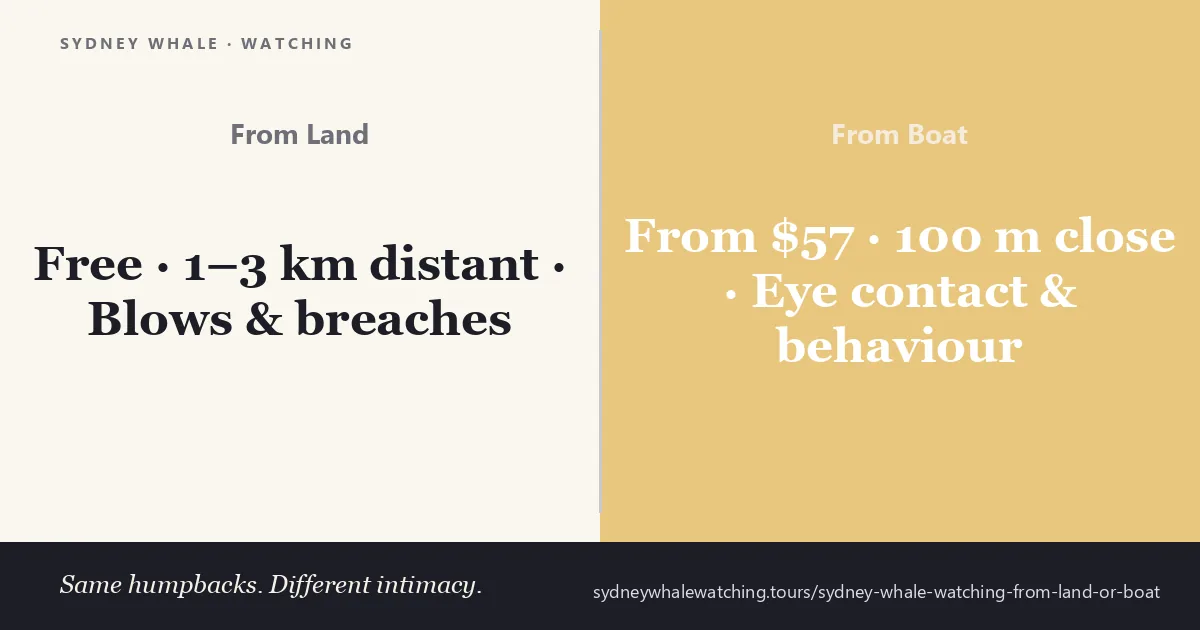
Land or boat? Quick comparison
| Land (headland) | Boat (cruise) | |
|---|---|---|
| Cost | Free | From $57 |
| Distance to whales | 1–3 km typically | Down to around 100 m |
| What you see | Blows, distant breaches | Blows, breaches, tail-slaps, eye contact |
| Behaviour detail | Limited — silhouettes | Full — bubble feeding, pec-waves, calves nursing |
| Time investment | Flexible, all day | 3 hours (catamaran) |
| Weather dependence | Need clarity + low glare | Goes in most conditions |
| Guaranteed sighting | No | Yes (Whale Guarantee on the cruise) |
| Best for | Casual viewing, runners, locals | Visitors, families, photographers |
The five best Sydney land-viewing spots
1. North Head, Manly
The northern jaw of Sydney Harbour. Wide open headland with multiple Pacific-facing viewpoints inside Sydney Harbour National Park. Whales pass close on Northbound and Southbound migrations because the corridor narrows here. The Fairfax Walk loop takes around an hour with several elevated lookouts.
- Access: ferry to Manly (30 min from Circular Quay), then bus 161 or a 30-minute walk uphill
- Best time of day: morning, with the sun behind you
- Facilities: parking, toilets, café at the Q Station
2. South Head and Gap Bluff, Watsons Bay
The southern jaw of the harbour. The Hornby Lighthouse Loop walk runs along sandstone cliffs with uninterrupted Pacific views. The Gap is famously dramatic — and famously close to the migration corridor.
- Access: ferry to Watsons Bay (about 25 min from Circular Quay), then 10-minute walk
- Best time: early morning for low glare, late afternoon for golden-hour light
- Facilities: fish-and-chips at Doyles, toilets, parking
3. Bondi to Coogee coastal walk
The 6 km cliff walk between Bondi and Coogee passes Tamarama, Bronte, and Clovelly. Multiple elevated sections give excellent Pacific views; whales are often spotted from the lookouts above Tamarama and Mackenzies Point.
- Access: bus or train to Bondi, walk south
- Best time: weekday mornings — weekends are crowded
- Facilities: cafés all along the route, beaches for breaks
4. Cape Solander, Kurnell
Across the bay from Sydney’s southern beaches, Cape Solander juts into the migration path on the south side of Botany Bay. Historically one of the most reliable land-viewing spots in greater Sydney. The viewing deck was rebuilt as a fully accessible concrete platform (upgraded in late 2023), suitable for wheelchairs and mobility aids and connected to designated accessible parking by a sealed footpath. The site hosts a long-running citizen-science whale-spotting programme each season — for 2026 the NPWS daily census runs from 24 May to 31 July, with the high-profile ORRCA Whale Census Day on Sunday 28 June 2026.
- Access: drive (around 40 min from CBD) or train to Cronulla + bus; vehicle entry to the Kurnell section of Kamay Botany Bay National Park is $8 per vehicle per day (free with a valid NSW National Parks Pass; free for pedestrians and cyclists)
- Best time: late June through July for Northbound peak; weekday mornings recommended as the car park fills early on June and July weekends
- Facilities: parking and the accessible viewing platform with interpretive signage; no toilets at the lookout itself as of 2026 (nearest are around 2 km away at Commemoration Flat) due to ongoing visitor-centre rebuild works
5. Bondi headland (Notts Avenue and Mackenzies Point)
The cliff above Bondi Icebergs and the lookout at Mackenzies Point offer elevated Pacific views close to the migration corridor. Less remote than North Head but very accessible.
- Access: walk from Bondi Beach
- Best time: weekday mornings
- Facilities: everything Bondi offers — cafés, toilets, transport
What you can actually see from land
A typical land-based sighting is a series of blows: short, vertical puffs of vapour 3 to 5 metres high. Through binoculars (any pair will do — 8x42 is ideal), you can resolve the whale’s back and dorsal fin between blows. Breaches — when the whale launches its body out of the water — are visible to the naked eye but small. Tail-slaps are similar. With patience and a sunny morning, expect to see something every 15 to 30 minutes during peak weeks (June-July, September-October).
What you don’t see from land: the size of the animal up close, the calf swimming alongside, the eye, the barnacles, the texture of the skin, or any of the social behaviour that happens between adults. Those are boat experiences.
What you can see from the boat that you can’t from land
- Scale. A 12-metre adult humpback half-out of the water at 100 metres’ range feels physically present in a way no photograph captures.
- Sound. The blow is loud — a sharp exhalation you hear and sometimes feel as fine spray.
- Calves. Southbound mothers travel with calves under a year old. From a boat you see them nursing, breaching for practice, and learning to fin-slap.
- Group behaviour. Heat runs, where multiple males compete for a single female, are dramatic and impossible to read from a distant headland.
- Sydney Harbour scenery on the cruise out. The catamaran passes the Opera House, Fort Denison, and the Harbour Bridge — a guided tour through the harbour before the whales arrive.
The “do both” recommendation
Sydney visitors who book a cruise and also spend a morning on a headland walk consistently report that the two experiences complement each other rather than competing. A headland walk gives you the migration as a phenomenon — animal after animal passing along the coast for hours. The cruise gives you a single sustained encounter with a specific pod. Together they tell the whole story.
If you have one day in Sydney during whale season, take the cruise — you’ll see more. If you have three or four days, do one headland walk plus one cruise.
A note on respect and acknowledgement
Sydney’s coastline is the unceded Country of the Gadigal people of the Eora Nation (inner Sydney coast, including Sydney Cove and the eastern beaches) and the Cammeraygal people (Lower North Shore, including the Manly headlands). Whales have long held cultural and spiritual significance to coastal Aboriginal peoples up and down the NSW coast — though the most documented whale traditions in this region belong specifically to the Thaua people of the Yuin Nation, several hundred kilometres south of Sydney at Twofold Bay (Eden). The Thaua sustained a multi-generational partnership with a pod of orcas known as beowas, culminating in the well-documented story of the orca Old Tom (died 17 September 1930), whose skeleton remains on display at the Eden Killer Whale Museum. That tradition is distinct to Yuin Country and should not be conflated with Gadigal or Eora practice.
The early colonial whaling industry in Sydney centred on Sydney Cove (The Rocks) from 1791 onward, with later processing at Mosman Bay and Neutral Bay, and a shore-based whaling station at Watsons Bay. Bondi itself was never a whaling village — though the cliffs at Ben Buckler at North Bondi were used as a whale lookout. Australia banned commercial whaling outright in 1979 (codified in the Whale Protection Act 1980); the East Australian humpback population that boats and headlands now watch has recovered from a 1965 low of around 200 individuals to today’s estimate of 50,000-plus. Modern Sydney’s role as a whale-watching destination — based on conservation rather than hunting — is a stark contrast worth holding in mind. When you walk a headland or take a cruise, you are participating in the same coastline that Aboriginal peoples have read for tens of thousands of years.
Ready to Book?
Land-based viewing is free, beautiful, and uniquely Sydney. A cruise puts you next to the whales themselves — close enough that the photographs change from “I think that’s a whale” to “look at the eye.” Most visitors do both, in either order.
Check availability for the scenic whale-watching cruise →
Rated 4.6/5 by 319+ verified guests. From $57, 3-hour cruise from Eastern Pontoon Wharf, Circular Quay. Whales guaranteed, free cancellation up to 24 hours before.
Watch Humpbacks Breach Off Sydney Heads
Join 319+ verified guests rated 4.6/5. Whales guaranteed, 3-hour scenic cruise from Circular Quay, expert commentary, onboard photographers, spacious catamaran — all included. Free cancellation up to 24h.
Check Availability & Book