The Best Time for Sydney Whale Watching
Month-by-month guide to humpback whale season in Sydney — Northbound vs Southbound migration, peak weeks, weather, and which month suits which traveller.
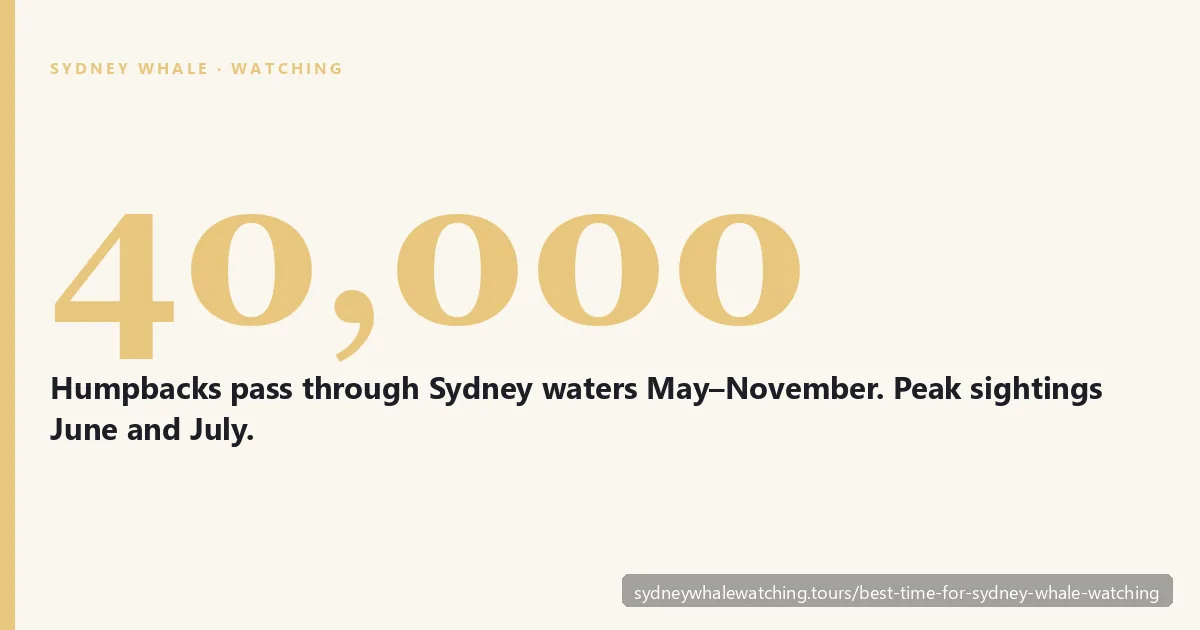
Sydney sits directly on one of the busiest humpback migration corridors on the planet — and the corridor keeps getting busier. East Australian humpbacks were estimated at around 40,000 individuals when the species was removed from Australia’s threatened list in 2022; the latest 2026 estimates from Macquarie University Cetacean Research and NPWS put the population at 50,000 or more, with some models forecasting up to 60,000 this season. The recovery has been described as approaching carrying capacity — a near-maximum biological growth rate of around 10–11% per year, sustained for two decades. The window is sharply defined: from late May through early November, the whales are here in numbers; outside those six months they are essentially absent. This guide breaks down exactly which weeks within that window deliver the best viewing, what behaviour to expect, and how the weather and water stack up against your itinerary. If you already know your travel dates, head straight to the scenic whale-watching cruise to check availability.
Sydney’s two humpback migrations, in plain English
Humpbacks (Megaptera novaeangliae) make a round-trip of around 10,000 kilometres each year. Sydney watches both legs.
- Northbound (May to August). Whales leave Antarctic krill-feeding grounds and swim north to give birth in the warm waters of the Coral Sea and Great Barrier Reef. They travel fast and direct, often in tight groups, and are heading away from food — so they’re calorie-loaded and energetic. Breaches, tail-slaps, and pec-waves are common.
- Southbound (September to November). The same population returns south with newborn calves. Pace is slower because mothers conserve energy and calves can’t yet swim long distances. You see more nursing behaviour, mother-calf bonding, and very young animals practising breaches. Some southbound pods linger in NSW bays for days.
Sydney sees both directions because the migration corridor runs roughly parallel to the coast, 1 to 8 kilometres offshore. The southbound leg is also assisted by the East Australian Current, which flows down the NSW coast at a core speed of around 2 to 3 knots — the same current Pixar made famous in Finding Nemo, and a real factor in why returning mothers and calves can travel comfortably even when they are conserving energy. Off Sydney Heads the current is often dominated by warm-core eddies, so flow can locally spike or stall.
The recovery in numbers
It is worth pausing on the population trajectory, because it shapes everything else in this guide. After commercial whaling closed Australia’s last station at Cheynes Beach (WA) in 1978 and the country imposed a full ban in 1979, the East Australian humpback population had collapsed to around 200 surviving individuals — some retrospective models put it as low as the low hundreds. By 2008 the count had reached roughly 11,000. The 2022 estimate of around 40,000 triggered the species’ removal from Australia’s threatened list under the EPBC Act. The 2026 estimate sits at 50,000 or more, with NPWS publicly forecasting a “record-breaking” 2026 season and Macquarie University modelling pointing to figures as high as 60,000. In practical terms for visitors: the chance of seeing a humpback off Sydney in June or July is higher in 2026 than in any year since modern records began.
Month-by-month breakdown
| Month | Migration phase | Sighting likelihood | Behaviour highlights | Sea conditions |
|---|---|---|---|---|
| May | Northbound (early) | Building | First scout pods, fewer animals | Cooler, more swell |
| June | Northbound (peak) | Excellent | Large adult pods, frequent breaches | Cool, occasional swell |
| July | Northbound (peak) | Excellent | Highest sighting density of the year | Cool, calmer afternoons |
| August | Northbound (late) | Very good | Adult stragglers, some early returners | Cool, can be windy |
| September | Southbound (early) | Excellent | First mothers with newborn calves | Warming, calmer |
| October | Southbound (peak) | Excellent | Cow-and-calf pairs, nursing behaviour | Mild, often glassy mornings |
| November | Southbound (late) | Tapering | Last calves of the season | Warming, generally pleasant |
The four standout months are June, July, September, and October. May and early November still produce sightings but density is noticeably lower, and the Whale Guarantee — a complimentary re-cruise voucher if no whales are seen — exists precisely because shoulder-week trips occasionally miss.
If you want one specific anchor date, mark Sunday 28 June 2026 — the annual ORRCA Whale Census Day, when volunteer counters fan out across NSW headlands including Cape Solander (Kamay Botany Bay National Park), whose own NPWS-coordinated daily census runs from 24 May to 31 July 2026. Census days are the busiest land-viewing days of the year and a useful “peak Northbound” marker even if you book a boat rather than join from a headland.
How to choose between Northbound and Southbound
The two halves of the season deliver genuinely different experiences. Choose by what you most want to see.
Pick June or July (Northbound peak) if you want
- The single highest density of sightings — multiple pods in a single cruise is normal
- High-energy behaviour: full breaches, tail-throws, and pectoral fin slaps; this is the leg where males race north and pod fights are most often seen
- Larger pods of adult whales travelling together
- The Tasman sea-surface temperature off Sydney Heads sits at around 18–20°C in June–July (it bottoms out closer to 17°C in late August) — bring a warm jacket
Pick September or October (Southbound peak) if you want
- Mothers with newborn calves — often the most emotionally striking sightings
- Calmer, more “personal” encounters; pods are smaller and slower
- Milder air temperature and longer daylight (closer to summer)
- A higher chance of glassy-water mornings ideal for photography
Locals split fairly evenly between the two camps. First-time visitors tend to prefer Northbound for the pure spectacle; repeat visitors and families with young kids often prefer Southbound for the calm and the calves.
Weather and sea conditions through the season
Sydney’s whale season spans the back half of autumn through to early summer, so conditions shift noticeably across the six months.
- Air temperature on the water: typically 10°C cooler than the CBD because of wind chill and sea-spray exposure. June-July CBD highs sit around 17–18°C, so plan for an effective 8–10°C feel on the open deck.
- Sea state: the Tasman Sea is open ocean. June-August sees more frequent southerly swells; September-October mornings are usually the calmest of the season.
- Visibility: rarely an issue — Sydney coastal air is clean and the sun angle is good through most of the day. Photographers tend to favour early-morning departures for soft side-lighting.
- Rain: Sydney is no rainier in whale season than in summer; if anything, June-July are among the drier months of the year. Light rain rarely cancels a cruise.
What about whale sightings outside May-November?
Outside the migration window, humpback sightings off Sydney are essentially zero — the population is in Antarctic feeding grounds (December-April) or already past Sydney heading north (early May) or south (late November). A small number of other species are present year-round:
- Bottlenose dolphins — common around Sydney Heads in any month
- Common dolphins — frequent in offshore waters
- Pygmy blue whales — extremely rare Sydney sightings; mostly Western Australia
- Southern right whales — historically common around Sydney, now very rare; occasional winter visitor in NSW
If you’re in Sydney outside the May-November window, the Port Stephens dolphin and koalas day trip is the closest year-round wildlife alternative.
When to book your cruise
Peak-month weekends (Saturday and Sunday in June, July, September, October) book out a week or more in advance, especially during NSW school holidays. Weekday morning slots tend to have the best availability and the calmest sea conditions. The scenic cruise offers free cancellation up to 24 hours before departure, so booking a few weeks ahead carries no risk if your plans shift.
A note on the Whale Guarantee
The Whale Guarantee is straightforward: if no whales are spotted on your trip during the official May-November season, the operator issues a complimentary re-cruise voucher valid for the rest of that season. In practice, sightings during the four peak months are extremely consistent — the cruise route follows the migration corridor directly — but the guarantee removes the lottery feel from shoulder-month bookings. It does not apply outside the May-November window.
Ready to Book?
The best time to see Sydney’s humpbacks is during the four peak months — June, July, September, and October — but any week from late May through early November is a genuine whale-watching opportunity, backed by the Whale Guarantee.
Check availability and book the scenic whale-watching cruise →
Departing daily from Eastern Pontoon Wharf, Circular Quay. Rated 4.6/5 by 319+ verified guests. From $57, whales guaranteed, free cancellation up to 24 hours before departure.
Watch Humpbacks Breach Off Sydney Heads
Join 319+ verified guests rated 4.6/5. Whales guaranteed, 3-hour scenic cruise from Circular Quay, expert commentary, onboard photographers, spacious catamaran — all included. Free cancellation up to 24h.
Check Availability & Book